Neon Genesis Evangelion


Everybody’s discussing it, everybody’s talking about it, everybody’s badmouthing it. Enough already! And us? Could we possibly let ourselves “miss out on somethin’”? No! So here’s your review! (I accept no responsibility for attacks of nausea, diarrhoea and other ailments resulting from reading this article. – WDIM’s note).

Neon Genesis Evangelion is the latest and long-awaited (by me, at least) animated series from the Gainax studio, following the success of the previous Nadia: The Secret of Blue Water. For the occasion the magnificent trio that created Nadia has got back together (Hideaki Anno directing, Yoshiyuki Sadamoto on character design, Shiro Sagisu on music), managing to turn out a dynamic series (is that a bad pun, by any chance?) that is innovative in several respects. The small number of episodes aired (26, but believe me, they’re more than enough) and the great production effort have made it possible to reach a technical standard that has rarely (if ever) been achieved by a television series. The animation is decidedly above the norm, very fluid and fast, reaching its peaks in the fight scenes (the Evas seem alive) while staying fairly consistent. The backgrounds are very carefully done (the overall image of the Geofront is beautiful)(but that isn’t a background! – Ryo’s note)(Well, so what, it’s beautiful all the same), and the atmosphere in which the characters move comes across very well thanks to a careful use of colour and shadow. Special mention goes to the mecha design by Sadamoto and Ikuto Yamashita. Breaking with the usual graphic conventions for robots (forget Mobile Suits, Valkyries and the like), they managed to create the Evas, whose hallmark is a thin, snappy line (basically a bundle of nerves; you know Bruce Lee?), and the Angels, whose main characteristic is… strangeness (Hey! What is that thing? A ball, a sausage, a meatba… – Goku’s note) (It’s an angel. – WDIM’s note) (Oh! – Goku’s note). The (Japanese) voice acting is excellent and engaging, with Megumi Ogata (Shinji) (He was voiced by a woman? – Goku’s note, astonished) and Megumi Hayashibara (Rei) standing out; after so many light roles (Ai in Video Girl Ai, female Ranma, Pai in 3x3 Eyes, etc.) she takes on a more dramatic one (with excellent results, I’d say. – Ryo’s note).
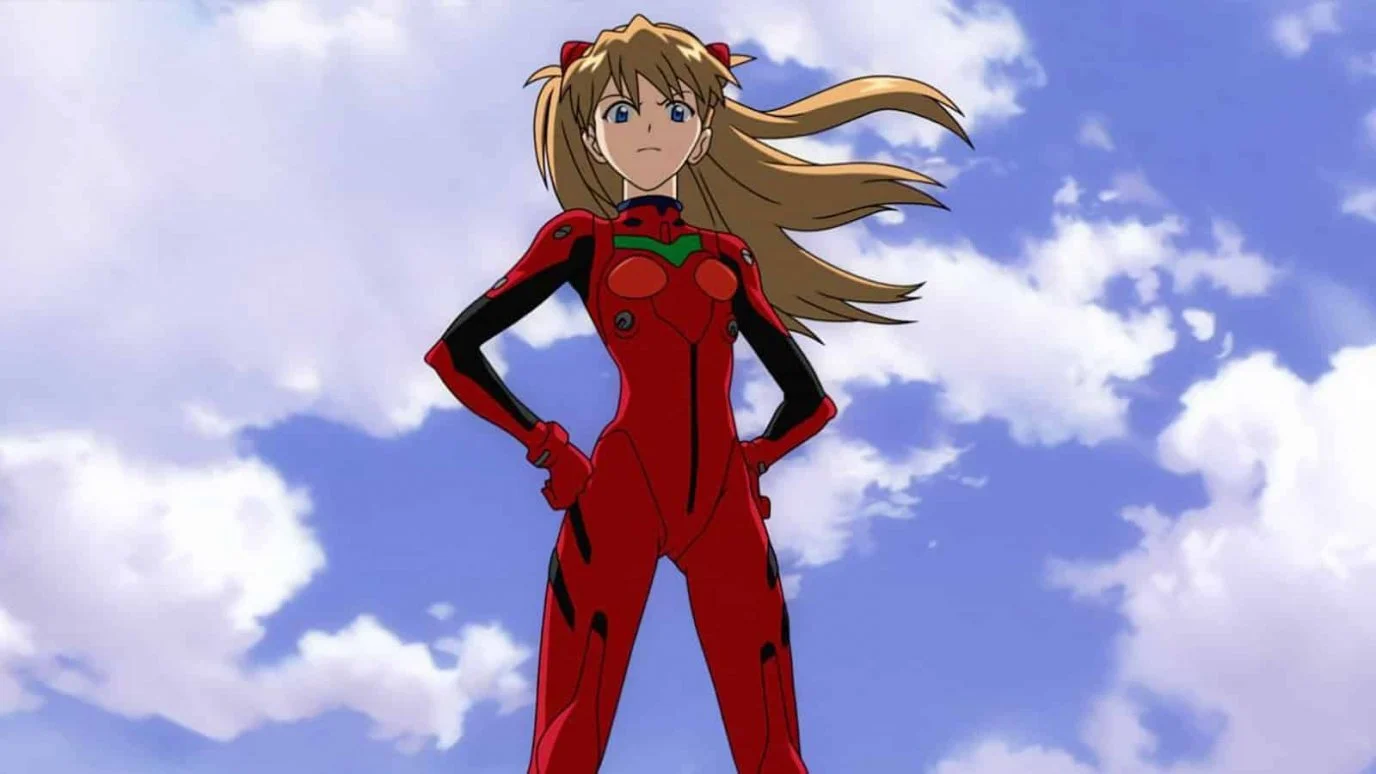
As for the music, what can I say? Magnificent (Then why did you ask, if you already knew? – Tribal’s note)! Sagisu manages to marry (More of a priest than a musician… – Ryo’s note) dynamic (Again???– Ryo’s note), rhythmic pieces (those of the fights, for example) with calmer, lighter ones (the everyday-life scenes), all the way to more unusual tracks, made of dark, diaphanous (almost metaphysical) music (Ohm… ohm… – Pelo’s note) that underlines the moments of dialogue and introspection. Worthy of note are Handel’s “Hallelujah” (at first it may make you wince, but after a few minutes you realise it’s perfect) in episode 22 and the “Ode to Joy” by Schiller-Beethoven in episode 24. (Yes! But what’s the story? – Goku’s note).

So… the story and the interaction between the various characters are the real strength of the series. The plot is built in a particular way. It revolves around a certain number of mysteries that thicken as the episodes go by and produce a mechanism of secrets and revelations, of the “said” and the “unsaid”, that carries the viewer along and instinctively leads them to ask themselves a series of questions: who are the Angels? Where do they come from? What do they want? (Who are we? Where do we come from? Where are we going? What will I do on Saturday night?)(And above all, why won’t Windows ‘95 start? – Ryo’s note), the answers to which, perhaps, depend on watching the following episodes.

(Ugh! The storyyy… – Goku’s note) OK, OK! The story… Following the impact of a meteorite in the Antarctic region, the polar ice cap melts, submerging coastal cities (Tokyo included) and raising the sea level. This event is called the “Second Impact”. Fifteen years after the “Second Impact”, a gigantic creature attacks Japan (Always Japan, never once do they attack, I don’t know, Hungary! – Ryo’s note), heading for Tokyo-3. The United Nations command orders a general counterattack, bombarding the creature with every weapon available. The attack proves ineffective because of an impenetrable force field (called the A.T. Field) surrounding the being. Realising their own powerlessness, the United Nations hand control of operations over to a special agency (Goddess of rescue. – Ryo’s note), called Nerv (based in Tokyo-3), headed by Gendo Ikari. Gendo sends for his son Shinji, whom he hasn’t seen for 3 years, to make him the pilot of a special combat unit called Eva-01. Once Shinji arrives, he is practically “forced” to climb into the Eva to go and defeat the creature threatening them. Shinji, however, is badly beaten. The Eva slumps lifeless against the city’s skyscrapers, its head pierced by a blow from the Angel (as Gendo calls the creature). When it seems all is over, the Eva starts moving on its own and, accompanied by assorted roars (I wouldn’t know what else to call them), literally tears the Angel to pieces. That is a (very condensed) summary of the first two episodes. Worthy of note is the direction of the second episode, in which, at the climax of the fight, the viewer’s attention is shifted to later events, only to return to the battle by means of a flashback.
As the episodes go by, the story takes shape with greater precision; new characters and other Eva units enter the scene. Unfortunately, because of the very structure of the work, revealing more would be a crime against those who haven’t seen the series (as a certain fanzine called… cough, cough did – Ryo’s note).
Currently the Evangelion manga is being published in Japan, serialised in Shonen Ace Monthly, and has reached its 3rd volume so far.
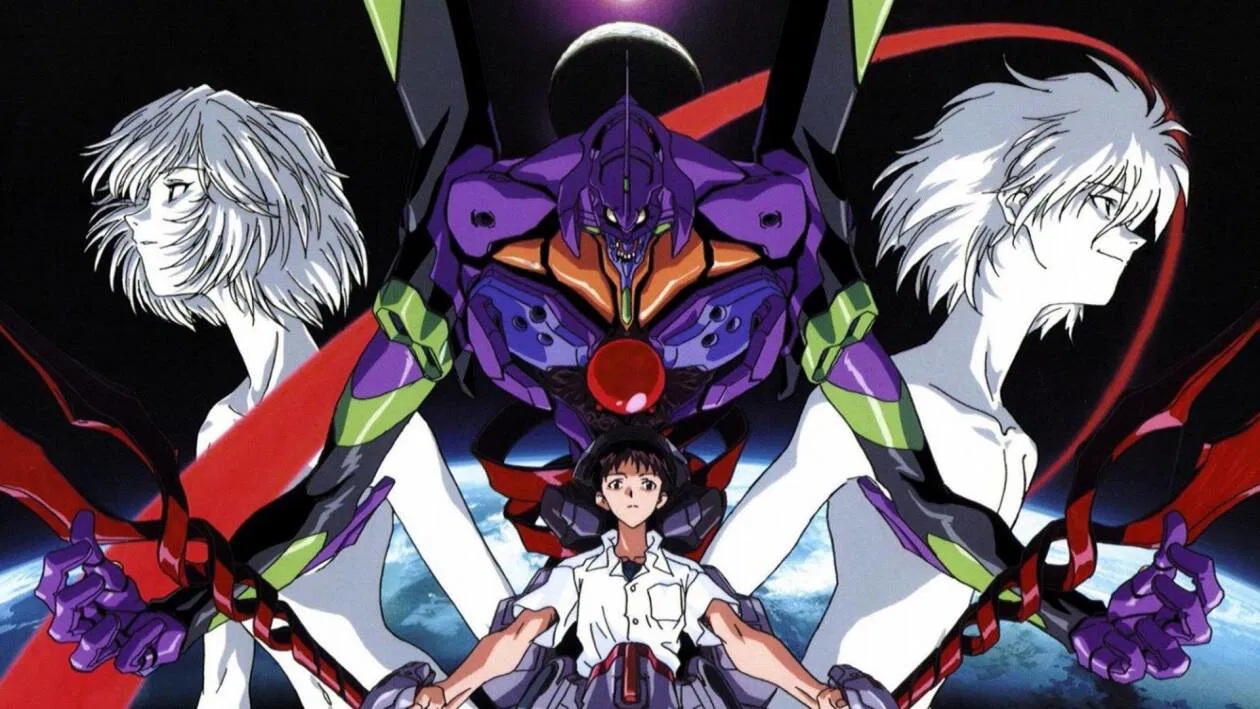
The design respects that of the series (after all, Sadamoto is in charge of it once again), almost (Drop the “almost”. – Ryo’s note) managing to recapture on paper the same atmosphere as the animated series. The story follows (at least so far) the original, departing from it in some points and being expanded in others, suggesting a work of wider scope, with a deeper analysis of the relationships between the protagonists. The rights to the comic seem to have already been bought by a publisher of ours, which suggests an Italian version coming soon (We have a few suspicions, here’s a hint: it’s not Star… – Ryo’s note). In March, again in Japan, the 1st Evangelion film (Death and Rebirth) was screened, made up of two parts. It takes up and expands the story, clarifying some points that remained obscure in the series. The 2nd and concluding film, “The End of Evangelion”, will be screened in June (I want to see it! Tribal, shall we leave for Japan?)(You paying? – Tribal’s note)(OK… I’ll wait. – WDIM’s note) (wait, I’ll ask Goku if he can teach me teleportation. – Tribal’s note).
All in all (Thank goodness! – Ryo’s note, who is sick of typing), Neon Genesis Evangelion is a gripping, top-quality series. Its only flaw may be, for a certain type of viewer, its excessive cryptic quality and the fact that not everything is explained from A to Z, but that is a purely subjective matter.
Published in: Website: Tiphares00